
Fire Ball vs Conventional Fire Extinguisher
A conventional fire extinguisher needs a person to operate it. A fire ball activates on its own. Each does a different job – here is how they compare and why most shops, godowns and homes benefit from having both.
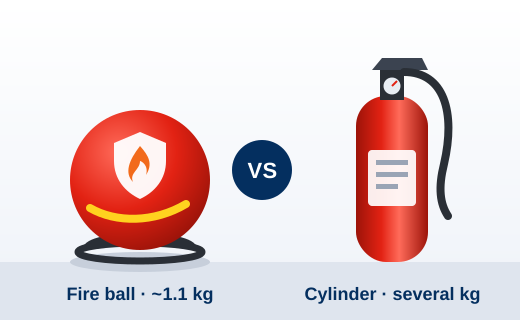
Side-by-side comparison
| Feature | Automatic Fire Protection Ball | Conventional fire extinguisher |
|---|---|---|
| How it starts | Automatically on contact with flame, or rolled/tossed into the fire | A person must pull the pin, aim the nozzle and squeeze the handle |
| Works when nobody is there | Yes, when placed where the fire starts | No |
| Skill needed | None – anyone can roll or toss it | Basic training recommended |
| Distance from the fire | Can be thrown from a safe distance, or works on its own | User must stand within a few metres of the fire |
| Weight | About 1.1 kg | Usually several kilograms |
| Pressure | Non-pressurised | Pressurised cylinder |
| Maintenance | None; replace after 5 years or after use | Regular inspection, servicing and refilling (IS 2190) |
| Fire alarm | Loud burst (about 138 dB) alerts people nearby | No built-in alarm |
| Extinguishing agent | ABC dry chemical powder (IS 14609) | Depends on type – ABC powder, CO₂, water, foam and others |
| Best for | Unattended, high-risk spots and a fast first response | Actively fighting a fire; required by fire safety rules |
Conventional extinguishers vary by type and size; this table describes typical portable models.
Why most places should have both
Many fires in shops and godowns start when nobody is present – after closing time, at night or on holidays. A conventional extinguisher cannot help then, because someone has to use it. A fire ball placed at the risk point can react to the first flames by itself and raise the alarm.
When people are present, a properly maintained fire extinguisher lets a trained person actively fight a fire, and it is usually required by local fire safety rules. The fire ball adds a layer of protection; it does not replace the extinguishers, alarms or sprinklers your premises need.
A note on CO₂ extinguishers in occupied rooms
Carbon dioxide does not support life. Commentary on the National Building Code of India (Part 4 – Fire and Life Safety) notes that CO₂ is unsuitable for areas that are normally occupied by people. The fire ball uses no CO₂ – its ABC powder is non-toxic according to the product's safety data sheet.
Quick guide: which one when?
- Electrical panel or meter board: fire ball mounted nearby, plus an ABC or CO₂ extinguisher at hand (CO₂ only where the room is not normally occupied).
- Godown or store room locked overnight: fire balls near the stock and wiring, plus extinguishers at the entrance.
- Kitchen: a fire ball close to (not above) the cooking area, plus a suitable kitchen extinguisher.
- Home: fire balls near the meter board and kitchen – an easy first step for families.
Not sure what you need? Ask SS Enterprises.
Protect your shop, godown or home today
Call or WhatsApp SS Enterprises for price, bulk orders and help choosing the right places to install fire balls.